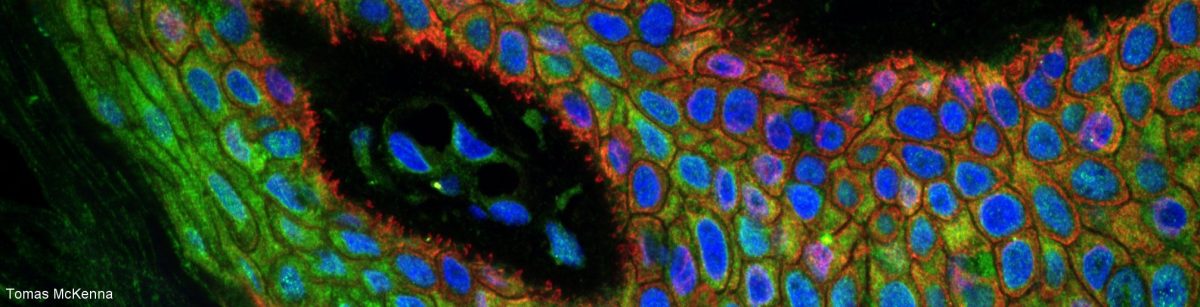
Living Architectures

Amazing images of cells and pseudo cells on a miniature pattern replicating the facade of the Musée d’Orsay in Paris! The pattern was used to study the capacity of cells and cytoskeletal component to self-organise.

It was published by Manuel Théry and the CytoMorpho laboratory as a FocalPlane post and displayed as a night-show in Paris.

The conclusions of the experiments are highly inspiring, at the border between Biology, Art, Architecture and Philosophy. 😀

Conclusions

All of these experiments illustrate that it is by constantly breaking down that living systems are able to rebuild themselves by adapting to changes in their surroundings. The bonds between biological components are so fragile that they can be easily broken and rebuilt, which gives living structures great plasticity. This plasticity allows cells to constantly adapt to their environment. Unlike inert materials, in which the strength of the bonds allows them to resist and endure, it is the fragility of these bonds that allows living systems to constantly reinvent themselves. But their plasticity is also their weakness. If the balance between destruction and construction is not perfect, the system cannot hold together and dies quickly.

Cells thus use their internal dynamics to explore every possibility, without goal or intention, simply because it is possible. Anything too unstable will collapse and make way for other attempts. Cells therefore spend their time playing with the limits of their stability. Most of them will die as a result. We are today the product of an evolution paved by the death of trillions upon trillions of cells. These adventurers did not attempt to achieve a specific goal that would have made them more robust or more efficient. They tried everything made possible by their internal dynamics.

Image: Nevena Morel


Train-the-Trainer course 2026

Do you train others to use light microscopy and would like to improve your training?

Together with Rhonda R. Powell from Clemson University in the USA, I will give the second edition of the online course “Magnify your impact: Train the Microscopy Trainer”.

This practical, interactive, online course is intended for anyone with experience training people to use light microscopes, including Core Facility Staff and Industry Applications Specialists.

During the course, you will focus on improving your OWN training. By the end of the course, you will be able to:

  • Write a list of learning objectives for your own microscopy training
  • Incorporate new pedagogical tools in your microscopy training
  • Evaluate the quality of your training using assessments and feedback

The application page is open until the 1st of August.

Free, online microscopy course by the LCI core facility

Dear all

Kindly forward to anyone who might be interested.

It is my pleasure to invite you to follow our free (no registration) online microscopy course.

The course schedule and Zoom link are found our course webpage.

The public program (everything in blue in the course schedule) starts next week on Thursday 22th of Jan and runs until the 13th of February.

Here is a selection of what we will talk about:

  • Optics and image formation,
  • How microscopes work
  • Objectives and refraction index
  • Cameras and detectors, Noise and background, Bit depth and saturation
  • Sample preparation, Immunostaining, Clearing
  • Resolution and contrast, Nyquist sampling, how to choose microscope settings
  • Data handling, how to make article figures, Requirements for image analysis, Colocalization, Ethics
  • Image processing and analysis

All lectures will be broadcasted live on Zoom, recorded then posted the same day on our Youtube channel.

The course syllabus with the Learning Objectives can be downloaded here.

Do not miss the kind testimonies on our course webpage! 🙂

The LCI core facility team, Stockholm, Sweden

3D imaging symposium

Dear all

An interesting whole-day 3D imaging symposium at Scilife on the 4th of December. Many really inspiring talks! 🙂

Time to apply to the LCI Microscopy course! :)

Dear all

You are now welcome to apply to join the LCI light microscopy course (21 Jan – 13 Feb 2026) ‘Microscopy: improve your imaging skills – from sample preparation to image analysis’ (6 credits).

The purpose of this fully online yet very applied course is to provide PhD students and researchers with enough theoretical and practical knowledge about their OWN sample and their OWN microscope, to enable them to:

    1. Prepare their sample and formulate their scientific question in a way that is suitable for reliable data extraction.
    2. Properly use the software and hardware available on the microscope they use in their lab/facility.
    3. Design their experiment based on image analysis requirements.

Application deadline 5th of November.

Course webpage.

Course syllabus, description and registration. Please carefully check the eligibility criteria and make sure to include all required items in your application.

Those who cannot register to the course can anyway follow any of the lectures (in blue on the schedule) as they will be publicly broadcasted live on Zoom and accessible to anyone without registration. The schedule and zoom link are on the course page.

Kindly help us spread the word. 🙂

The LCI team

Online course for microscopy facility staff: “Magnify Your Impact: Train the Microscopy Trainer.”

Dr. Sylvie Le Guyader (sylvie.le.guyader@ki.se) and Ms. Rhonda Powell (rhondar@clemson.edu) invite you to apply to the online course: “Magnify Your Impact: Train the Microscopy Trainer.”

This practical, interactive, online course is intended for anyone with experience training people to use light microscopes, including Core Facility Staff and Industry Applications Specialists.

During the course, you will focus on improving your OWN training. By the end of the course, you will be able to:

  • Write a list of learning objectives for your own microscopy training
  • Incorporate new pedagogical tools in your microscopy training
  • Evaluate the quality of your training using assessments and feedback

Please see the attached flyer for details and a link to the application, or visit https://tinyurl.com/magnifyyourimpactapplication

The application deadline is September 20, 2025. Applications will be reviewed in the order they are received. Questions about the application can be directed to Rhonda.

The course is sponsored by BNMI and Nordforsk.

Flemingsberg science fun!

Do you want to know more about working at a Biotech companies? Meet the companies located on the Flemingsberg campus! Join the Flemingsberg Science breakfast meetings (in English) every wednesday in Novum.

Useful tips on the Nikon E-learning platform

Dear all

Have a quick look at Nikon’s e-learning platform! There are many useful tips and reminders of what we teach during the LCI training and course. 🙂

For example, here is a reminder of how refractive index mismatch distorts your images and when you should be concerned. 🙂

High Speed Multiphoton Imaging of Dynamic Processes In Vivo at Stockholm University

Intravital people might be interested in this event at the Intravital Microscopy Stockholm University facility:

The online LCI microscopy course: Microscopy: improve your imaging skills – from sample preparation to image analysis.

Dear all

It is my pleasure to invite you to follow, online, free of charge and without registration, the LCI facility microscopy course Microscopy: improve your imaging skills – from sample preparation to image analysis. The public program starts on Tuesday next week (28th of Jan) and runs until the 13th of February.

As usual, all lectures are broadcasted live on Zoom and posted on Youtube every day, for the benefit of our far-away colleagues.

The aim for this course is to improve the microscopy skills of students and researchers who have already used a microscope to acquire digital images of fluorescent samples but feel that more knowledge could help them.

Here is a selection of what we will talk about:

  • Optics and image formation,
  • How microscopes work
  • Objectives and refraction index
  • Cameras and detectors, Noise and background, Bit depth and saturation
  • Sample preparation, Immunostaining, Clearing
  • Resolution and contrast, Nyquist sampling, how to choose microscope settings
  • Data handling, how to make article figures, Requirements for image analysis, Colocalization, Ethics
  • Image processing and analysis

Check our course webpage to see the course schedule (Broadcasted activities are in blue) and the Zoom link. Here is a full description of the course.

Scroll down to read the kind testimonies of our dear students! 🙂

We hope that you will enjoy the LCI facility online microscopy course!

Kindly forward to anyone who might be interested.

The LCI team

Follow us! :-)

Type your email address below to subscribe to our blog!